- Malawi to Mexico
- Hitchhiking to Arusha
- Malawi Independence Day
- India: Lessons from the Poorest of the Poor
Hitchhiking to Arusha
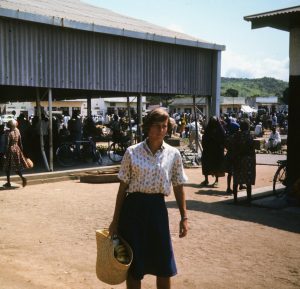
Wind from a passing vehicle flicked my skirt, disturbing a colony of flies on my legs. I watched, in shock, the last bus of the day disappear in a cloud of dust. The driver of the seriously overloaded Dar-es-Salaam-to-Nairobi bus only slowed down enough to yell out the open door something I didn’t catch. He waved and sped away.
The villagers waiting with me on the side of the road lifted cardboard suitcases, hoisted bundles on their heads and turned for home as if this was a daily occurrence. Women in bright kitenge wraps disappeared down the spider-web of trails into the bush.
After visiting with Cathy, a fellow Peace Corps volunteer, I’d planned to take the Nairobi bus to Arusha, rest up a bit and catch the 6:30 a.m. bus home to Mwanza, and there do a few lesson plans and tidy up my science labs before the first day of the new term.
What to do?
Cathy had dropped me off at this unidentified bus stop, a mango tree, basically, and was long gone to her clinic, deep in a sisal plantation. There might be more of a village beyond the road, where I could stay overnight. There would be no public accommodation and I was a stranger to that area, but there would be an offer of hospitality. That’s the way it was in the bush. It would be awkward for them to take in a mzungu, and uncomfortable for me. But a possibility.
Or I could stay where I was and wait. I had no blanket and only snacks, and no reason to think that tomorrow’s bus would be less packed.
I really had to get to Arusha by morning, or I’d have two days until the next bus to Mwanza. It would not make a good impression for me to miss our first staff meeting with our new headmistress.
My anxiety increased. A lorry stopped down the road and picked up one of the stragglers. Hitchhiking in the U.S. was never a good idea, but in Tanzania, few people could afford vehicles, and other Peace Corps volunteers I knew did it. Reluctantly, I realized hitchhiking was the only way to get to Arusha, if another vehicle came along before nightfall.
Eventually, an aged but sturdy British Leyland truck stopped, battered khaki with a rounded engine hood and short slats around the flat bed. Behind the cab boxes, cases of beer, a new motor, sisal bags fat with some lumpy tuber and cotton bags of flour lay in a haphazard pile. A bald spare tire lay on top of a greasy canvas tarp near the tailgate.
The driver’s glistening ebony elbow hung out the open window.
“Hujambo, Baba. Habari gani?” I greeted him with my friendliest smile.
“Nzuri, Mama.”
“Nakwenda Arusha?” I asked hopefully. I should have asked him about his family, but I was focused on my problem.
“Ndio, Mama,” the driver said amiably. He turned and mumbled something. A younger fellow hopped out, helped lift my pack into the back, and then stood back to let me climb in the cab. I settled myself in the middle of the seat, tucked my skirt around my legs to give the gear shift free play, and found a place for my dusty feet.
The question I should have asked the driver was when we would arrive in Arusha. The drive was only a few hours, so I might still have time to rest before the morning bus. That’s not quite the way it worked out.
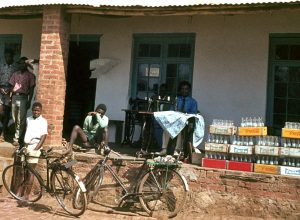
The driver avoided the largest holes, but the washboards were a special trial of vibration and loud truck, bouncing body noise. Conversation was difficult, but we managed some basics. Soon, we pulled up in front of a simple white sun-dried brick structure with red trim and a corrugated tin roof. Colorful metal signs advertised Sportsman cigarettes and Bata Shoes. It was a duka, one of the little stores that sold travelers cigarettes, plastic shoes, school supplies, greasy food and snacks. For the thirsty, there was warm Coke, orange Fanta or pombe, the local brew.
Without a word, the driver hopped down, slammed his door and went in, leaving me with the younger man in the cab. He was a kid, really, probably late teens, one of many who seemed to accompany people of importance, like my driver. Not filled out yet but all smiles.
After an awkward pause, he asked, “Jina lako nani?”
We exchanged names, family structures and towns of origin. No, I wasn’t married, nor did I have children. I was a teacher at Bwiru Girls School in Mwanza. He was Mohammed, from Same. It didn’t go much further. I was anxious to get moving and my Swahili was limited, since we teachers were encouraged to speak English with the students to improve their language skills.
The driver was gone for quite a while. Possibly, if I flagged down another of the infrequent vehicles, my very generous, albeit absent, host might be offended, which could leave me without any ride. As I ruminated, he returned and we hit the road again.
Odd, I thought. Nothing had been added to the load nor did he take anything into the store. Then I caught a whiff of pombe on his breath. Ever optimistic, I thought, OK, one (or two) for the road. Pombe can be rather weak. Not always, though.
I revised my arrival time, and slept.
When I awoke, we were stopping again. It was dark. The driver was gone even longer. I feared we would not make Arusha by morning.
The third duka, around midnight, was really jumping, with loud music and shouts from the patrons. One or two reeled out the door into the dark.
For over an hour Mohammed and I waited in the cab. No other vehicles passed by. Maybe the driver really had abandoned us this time. At a point when both of us had our eyes open, I asked Mohammed, “Dreva wapi?”
Mohammed knew where the driver was and showed me, his right forefinger poked into his left fist, grinning as he jerked his pelvis as well.
I made a face that I hoped conveyed annoyance, yet I felt helpless. I was only a passenger. I couldn’t very well be making demands, deny the man his pleasures.
But Mohammed repeated the gesture and added some. He pointed to me and then to himself, raised his eyebrows and grinned, and punctuated all this with more finger and fist action. Only someone raised in a barrel could not understand this pantomime. I grimaced, shook my head and said “Hapana,” as if he’d just offered me a mango or Fanta.
Plan B was based on our relative sizes. I figured I could deck him if he got too eager. I didn’t have much experience along the lines he suggested, and this scenario had never occupied any of my fantasies. He didn’t persist, but his offer worried me. And what about our driver?
Finally, he returned, not alone. His gait appeared steady. A tipsy bar patron grabbed hold of the passenger door handle and looked meaningfully at Mohammed. I was already as cozy with the driver as I intended to be. Mohammed got out, and after some laughing and pointing at me, the new man squished into the seat. Mohammed climbed up onto his lap, still smiling, his head cramped against the roof.
My odds were going down. So far everyone had treated me respectfully: I was mzungu, I was a teacher. My dress was discreet, not inviting advances. But I was, after all, a woman. This kind man was offering me a service, one I’d asked him for, without even mention of a fee. But danger signals tingled. Could I expect him to put my needs above his own and his friend’s?
Any woman traveling alone anywhere needed to be alert. That’s what I was. A woman. Alone. Alert. Ours was the only vehicle at the duka and if Plan B was hopping out next to a jumping beer joint on a lonely road in the middle of the night, it did not seem the wisest. My best chance to get to Arusha lay with this lorry.
The night was very long. I could only doze, lifting a sandy eyelid occasionally to look for anything that might indicate where we were. I hoped that whatever the driver did at the last stop included a nap and with luck, a cup of coffee. He seemed able to stay on the road and only weaved to avoid potholes. No animals showed up in the headlights for us to startle or hit, the greatest nocturnal danger. The few wild ungulate herds in the area were elsewhere that night. Domestic animals stayed in family enclosures after dark for protection against lions. Really, our only worries were potholes. And for me, time.

The sky finally began to lighten and with it, my spirits rose. The calm rhythm of the waving savanna grasses surrounded us. We were making good time. How silly of me to worry in the dark.
The truck rolled to a stop. I tensed. The motor seemed to be running fine.
All of us got out. I watched warily as the driver opened the hood and stared at the motor. He stuck his hand in and pulled and poked at invisible things. Occasionally, the assistant went to the cab to rummage for a tool. The other passenger took a leak behind the lorry and wandered over to watch the driver. They seemed to be ignoring me.
Not a man-made structure in sight, not even a dusty path to indicate people nearby. From the clues I had sleepily gathered, a few signposts and village names, I thought we were at least fifty miles from Moshe, and even further from Arusha. I squinted at my watch. 6 a.m. No hope for the bus to Mwanza or the staff meeting that day. I hated that thought, but things could be worse.
I hoped they wouldn’t be.
The pink dawn tinted a small rise in front of us. I turned to look back the way we had come, hoping for a cloud of dust. Instead Mount Kilimanjaro framed a stand of flat-topped acacia trees. Fresh sun leaked around the tiny cap of snow on its peak. Stunningly beautiful. But I couldn’t enjoy it.
The driver and his helpers prodded and fiddled with the accursed truck, and didn’t seem to like the results.
I wanted to scream, but couldn’t. I still needed the ride. Instead I gazed longingly down the road, trying to manifest another vehicle, anything to get to Arusha safely.

And lo! in a cloud of dust appeared a silver Mercedes Benz. Not bad for an apparition. It seemed astonishing, but was it? The car pulled up behind us with only one person in it, a dark and slender young man who stepped out. He stretched and shook out his light cotton shirt and slacks.
“Is there a problem, then? Can I be of any help?” He spoke in Swahili and then in English for my benefit.
“Hapana. Nzuri.” The lorry driver told him everything was fine.
I didn’t hesitate. “It looks like they will be a while here. I wonder if you might be headed as far as Arusha.”
“Certainly. I’d be delighted for the company. I’ve just come from Dar and it’s been a very long drive. A little conversation would be very welcome.”
His dusky complexion hinted at an East Indian origin, a good assumption since so many owned the stores in the country. They were known to be protective of their women, and he seemed charming. I climbed in with relief.
Then I learned that he was Greek. Did it make a difference? Maybe. I didn’t know, but stayed cautious.
More little houses, more cultivated fields. We zipped through Moshi and were approaching Arusha. We chatted the best two night-drugged people can, and then he asked, “Would you like to come to my home and meet my mother and have something to eat? Perhaps a wash up and a nap. If you were up all night like me, I’m sure you are tired. It’s just on the way into town.”

I hesitated.
“Oh, I assure you, I’m truly asking you just to have some tea. I have some urgent business to do, and I can send you on into town with my driver when you are ready.”
I said yes. The bus for Mwanza had departed without me, so I had plenty of time. He also sounded as if he really wanted to go home. He had a driver, somewhere. That was reassuring.
A little old mother was in fact waiting for him. Short and bent, she wore a simple cotton dress with a loose full skirt. Wisps of gray hair escaped her head shawl to frame her lined face. She was delighted to meet me, and graciously served some too-sweet fruit punch. Her son went off to take care of his business while we had a faltering conversation. She spoke very little English, and I spoke no Greek. When I was sent off with car and driver, I understood she bade me a fine journey.
The driver took me first to the bus station, where I saw, unbelievably, the 6:30 a.m. bus to Mwanza still idling. Of course! They were rarely on schedule. We left at 9:30 a.m., and I didn’t care when we arrived. I slept for most of the trip and at 2 a.m., the bus pulled into Mwanza. The town looked beautiful in the dark.
At a late breakfast the next morning my housemate, Kay, greeted me with agitation. School was starting, and we still did not have a headmistress.
It just didn’t seem important.
To the Top or return to Leopards at My Door, Fifth Break